Audio Brief Generator
Turn any topic, paper, or document into a spoken-word brief — tailored to how you'll listen.
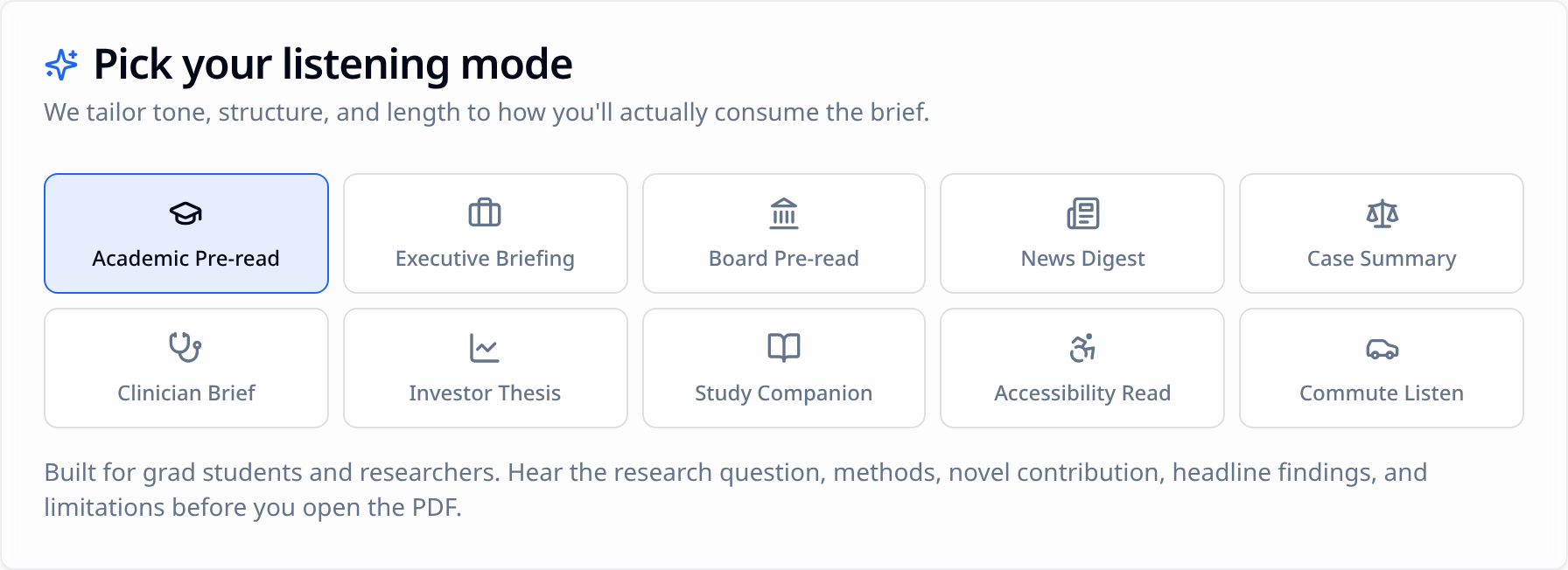
Pick your listening mode
We tailor tone, structure, and length to how you'll actually consume the brief.
Commute-friendly brief. Conversational tone, one main idea + three supporting points + one takeaway.
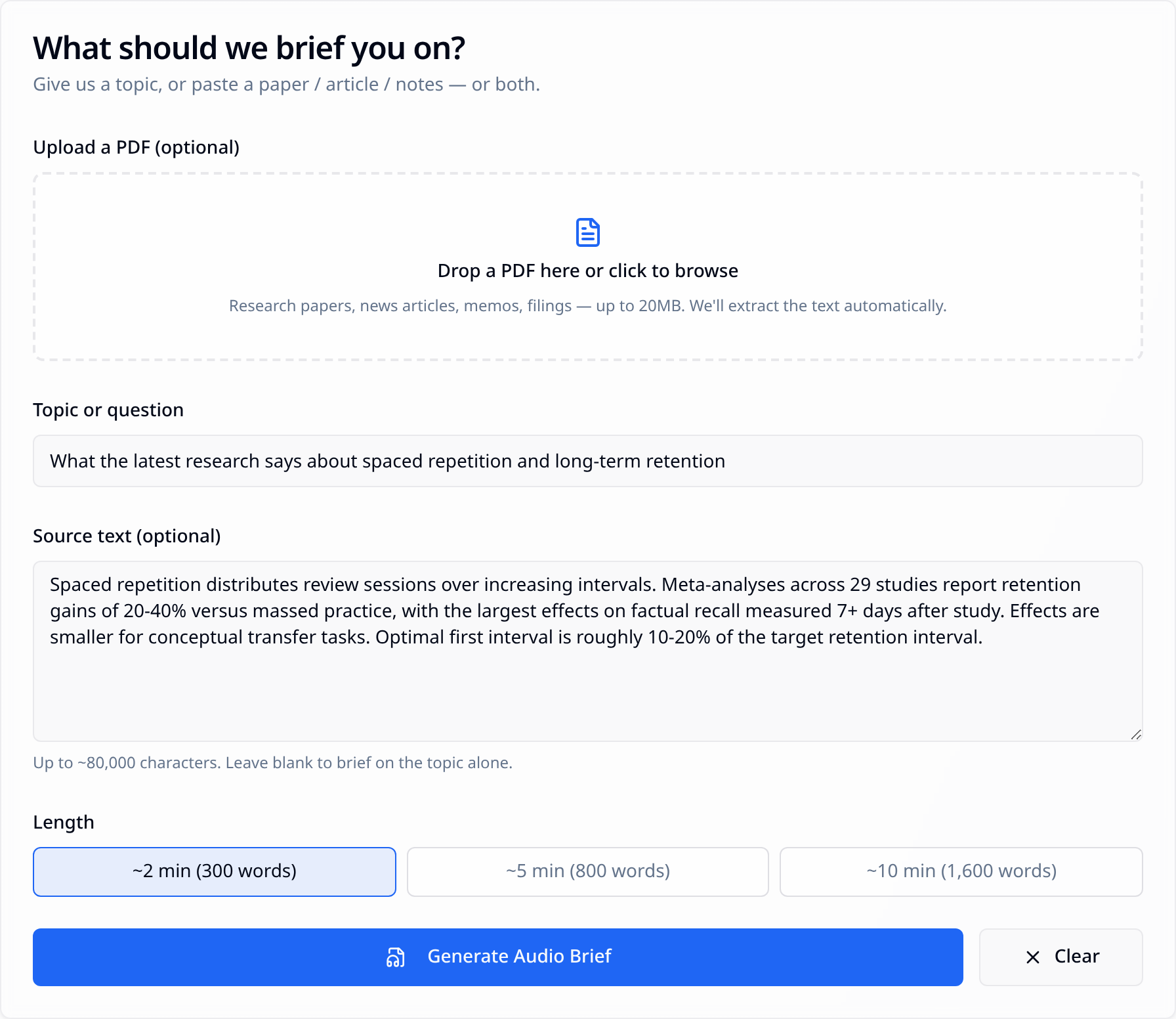
What should we brief you on?
Give us a topic, or paste a paper / article / notes — or both.
Up to ~80,000 characters. Leave blank to brief on the topic alone.
Try an example
Click a prompt to pre-fill the inputs — or drag a PDF above to ground the brief in your own source.
What you'll get
Ten listening modes — each rewrites the brief for a different audience, focus, and tone.
| Mode | Audience | What it emphasizes | Tone |
|---|---|---|---|
Academic Pre-read | Grad students, researchers triaging papers | Research question, methods, novel contribution, headline findings, limitations | Precise, neutral, scholarly |
Executive Briefing | Busy leaders needing a decision-ready TL;DR | Bottom line first, strategic implications, risks, recommended actions | Crisp, decisive |
Board Pre-read | Board members reviewing reports/memos | Material numbers, governance & risk issues, decisions the board must make | Formal, governance-focused |
News Digest | Anyone wanting a headline brief | What happened, why it matters, what to watch next | Punchy, neutral journalist |
Case Summary | Attorneys, paralegals | Parties, claims, key facts, holdings/rulings, practical takeaways (no legal advice) | Structured, professional |
Clinician Brief | Doctors, med students | PICO framework: Population, Intervention, Comparator, Outcome + effect size, evidence certainty, bedside relevance | Clinical, evidence-based |
Investor Thesis | Investors, analysts | Thesis, key metrics, catalysts, risks, what would change the view | Analytical, thesis-driven |
Study Companion | Students learning a concept | Clear teaching, analogies, 1–2 worked examples, ends with a 3-question self-quiz read aloud | Friendly tutor |
Accessibility Read | Users with dyslexia, ADHD, low vision | Plain language, short sentences, clear signposting ("first… next… finally"), no jargon | Calm, simple, paced |
Commute Listen | Drivers, walkers, gym-goers | 1 main idea + 3 supporting points + 1 takeaway, vivid framing | Conversational, podcast-style |
Quick way to choose
- Need to decide something fast → Executive Briefing or Board Pre-read
- Need to learn something → Study Companion or Academic Pre-read
- Need to stay informed while doing something else → Commute Listen or News Digest
- Need a domain-specific lens → Case Summary (legal), Clinician Brief (medical), Investor Thesis (finance)
- Need it to be easy to follow → Accessibility Read
Turn any paper, report or topic into a brief you can listen to
The Audio Brief Generator writes a spoken-word briefing and narrates it out loud. Upload a PDF, paste an article or just name a topic, pick how you'll listen — academic pre-read, executive briefing, commute listen and seven more modes — and you get a script written for the ear, plus AI narration you can play, scrub, speed up and finish on the way to class.
It is not text-to-speech bolted onto a summary. The brief is rewritten for listening first: numbers spoken in full, no bullet fragments, one idea per sentence, and a structure that matches why you're listening — findings and limitations for a paper, decisions and risks for a board pre-read, concepts and self-quizzes for revision.
Built for eyes-off listening
Ten listening modes
Academic pre-read, executive briefing, board pre-read, news digest, case summary, clinician brief, investor thesis, study companion, accessibility read and commute listen — each changes the tone, structure and emphasis of the script.
A real audio player, not a download
Play instantly with a draggable scrub bar, ±5 second skips, start-over, and 0.75x to 2x playback speed. Narration begins streaming while the rest of the audio is still being generated.
Grounded in your source
Drop in a PDF up to 20MB or paste up to 80,000 characters of an article, transcript or notes and the brief stays anchored to that source instead of drifting into generic background.
Script and audio together
The written brief sits under the player, so you can read along, copy it, download a .docx, or send it straight into a document in your Research Monkey workspace.
Three steps from link to summary
Paste a link, let the transcript be read, then read, jump and export — a two-hour lecture becomes a two-minute read.
Pick your listening mode
Choose how you'll consume the brief — academic pre-read before a seminar, commute listen on the train, board pre-read before a meeting. The mode sets tone, structure and length.
Add your source and length
Upload a PDF, paste an article or transcript, or just type a topic. Then pick ~2, ~5 or ~10 minutes of listening.
Press play
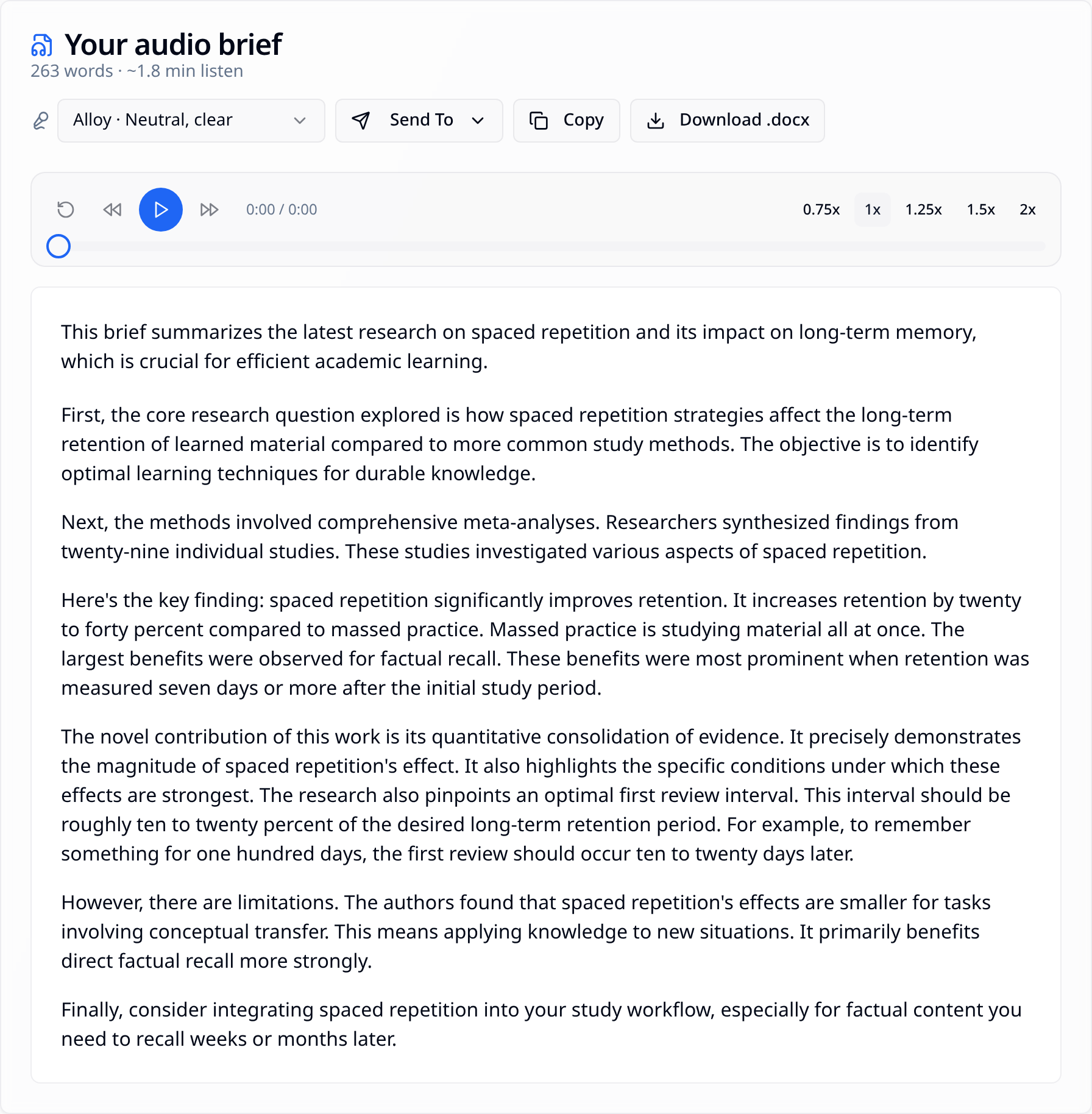
The brief is written, narrated and streamed into the player. Scrub, skip, change voice or speed, then copy, download or send it to your workspace.
1 credit per audio brief
Writing the brief costs a single credit, whatever the source length. Playing it back, changing the voice, adjusting speed, re-listening, copying and exporting are all free.
- A 40-page PDF and a one-line topic cost the same.
- Narration is included — there is no separate charge for the audio.
Who gets the most out of it

Grad students & PhD candidates
Pre-read a paper on the walk to the library: research question, methods, headline findings and limitations before you open the PDF.

Researchers & academics
Triage a stack of new literature by ear and decide which papers actually deserve a careful read.

Analysts & executives
Turn a 90-page industry report or filing into a five-minute briefing with the decisions, numbers and risks up front.

Commuters & accessibility users
Listen instead of reading — designed for dyslexia, ADHD, low vision, and anyone whose best study time is a commute or a workout.
See what a finished summary looks like
This is a real, unedited brief from the tool — an Academic Pre-read of research on spaced repetition. Press play to hear the narration, and read the exact script it was generated from underneath.
Spaced repetition and long-term retention
263 words · ~1.8 min listen
Listen to the finished brief
Generated end-to-end by the Audio Brief Generator — same script, same voice, nothing edited afterwards.
Text output
This brief summarizes the latest research on spaced repetition and its impact on long-term memory, which is crucial for efficient academic learning.
First, the core research question explored is how spaced repetition strategies affect the long-term retention of learned material compared to more common study methods. The objective is to identify optimal learning techniques for durable knowledge.
Next, the methods involved comprehensive meta-analyses. Researchers synthesized findings from twenty-nine individual studies. These studies investigated various aspects of spaced repetition.
Here's the key finding: spaced repetition significantly improves retention. It increases retention by twenty to forty percent compared to massed practice. The largest benefits were observed for factual recall, and were most prominent when retention was measured seven days or more after the initial study period.
The novel contribution of this work is its quantitative consolidation of evidence. The research pinpoints an optimal first review interval: roughly ten to twenty percent of the desired long-term retention period. To remember something for one hundred days, the first review should occur ten to twenty days later.
However, there are limitations. Spaced repetition's effects are smaller for tasks involving conceptual transfer — applying knowledge to new situations. It primarily benefits direct factual recall.
Finally, consider integrating spaced repetition into your study workflow, especially for factual content you need to recall weeks or months later.
Frequently asked questions
- One credit per brief, regardless of how long your source document is. Listening, re-listening, changing the voice or speed, copying and exporting cost nothing extra.
Ready to listen to your first brief?
Pick a listening mode, drop in a paper or a topic, and press play — one credit per brief, narration included.