Webpage Summarizer
Paste any URL and get an AI-powered summary with key takeaways, bias scores, citations, and claims to verify
Enter a Web Page URL
Works with news articles, research pages, reports, blogs, and more
Try an Example
Load a sample article URL to see what the summarizer produces
What You'll Get
TL;DR + Summary
One-sentence essence plus a concise overview
Key Takeaways & Stats
Bullet insights and ready-to-cite figures
Bias Detection Scores
Political lean, commercial interest, and emotional language scores
Claims to Verify
One-click send any claim to AI Fact Check Quotes
Auto-Citations
Ready-to-copy APA, MLA, and Chicago citations
Source Credibility
Publisher assessment, bias notes, and overall rating

Summarize any web page — articles, blogs, reports, news
Paste a URL and the Webpage Summarizer pulls the full article text, then reads it end to end and writes it back as something you can actually use: a TL;DR, a plain-English summary, the key takeaways in order, the numbers worth quoting, and the lines you can cite. A 3,000-word investigation becomes a two-minute read.
Because the summary is built from the page's real text rather than its meta description or headline, the takeaways line up with what the article actually says — useful when you need to cite a claim, check a statistic, or brief a team on a long report.
Reads the whole page, not the headline
The article text is extracted and analysed in full, so a 20-paragraph investigation gets the same coverage as a short blog post — no truncation mid-way.
Claims and statistics you can verify
Every key statistic and claim is pulled out separately, so you can fact-check a number or hand a quote to a colleague without re-reading the source.
Citations, ready to paste
The summarizer returns APA, MLA and Chicago citations for the source page, so you can drop the article straight into a bibliography.
Three steps from link to summary
Paste a link, let the transcript be read, then read, jump and export — a two-hour lecture becomes a two-minute read.
Paste the URL
Any public article, blog, news story or report.
Fetch & read
Full article text extracted and analysed end to end.
Read, cite, export
Skim the TL;DR, copy a citation, save to a document.
Summarize any page without leaving your browser
The Research Monkey Chrome Extension puts the Webpage Summarizer one click away on any article, blog or report — no copy-pasting URLs. Open the side panel on the page you're reading and get the same TL;DR, takeaways, quotes and citations right beside the source.
- One click on any page — the side panel reads the article you're already on
- Full summary in your browser: TL;DR, takeaways, statistics, quotes, citations
- Save pages to your Reading List and pick them up later in your dashboard
1 credit per summary
Each web page you summarize costs a single credit, no matter how long the article is — a 500-word blog post and a 10,000-word investigation cost the same.
Who gets the most out of it

Bloggers & writers
Digest a long reference article in minutes and pull quotable lines and citations to weave into your own posts.

Marketers
Track competitor blog posts and industry news — get the key takeaways and numbers without reading every word.

Students
Turn a dense assigned reading into takeaways and quotable lines before a seminar, then export the citations for your essay.

Researchers
Triage a long list of sources fast — pull the key statistic and claim from each article without reading every word.
See what a finished summary looks like
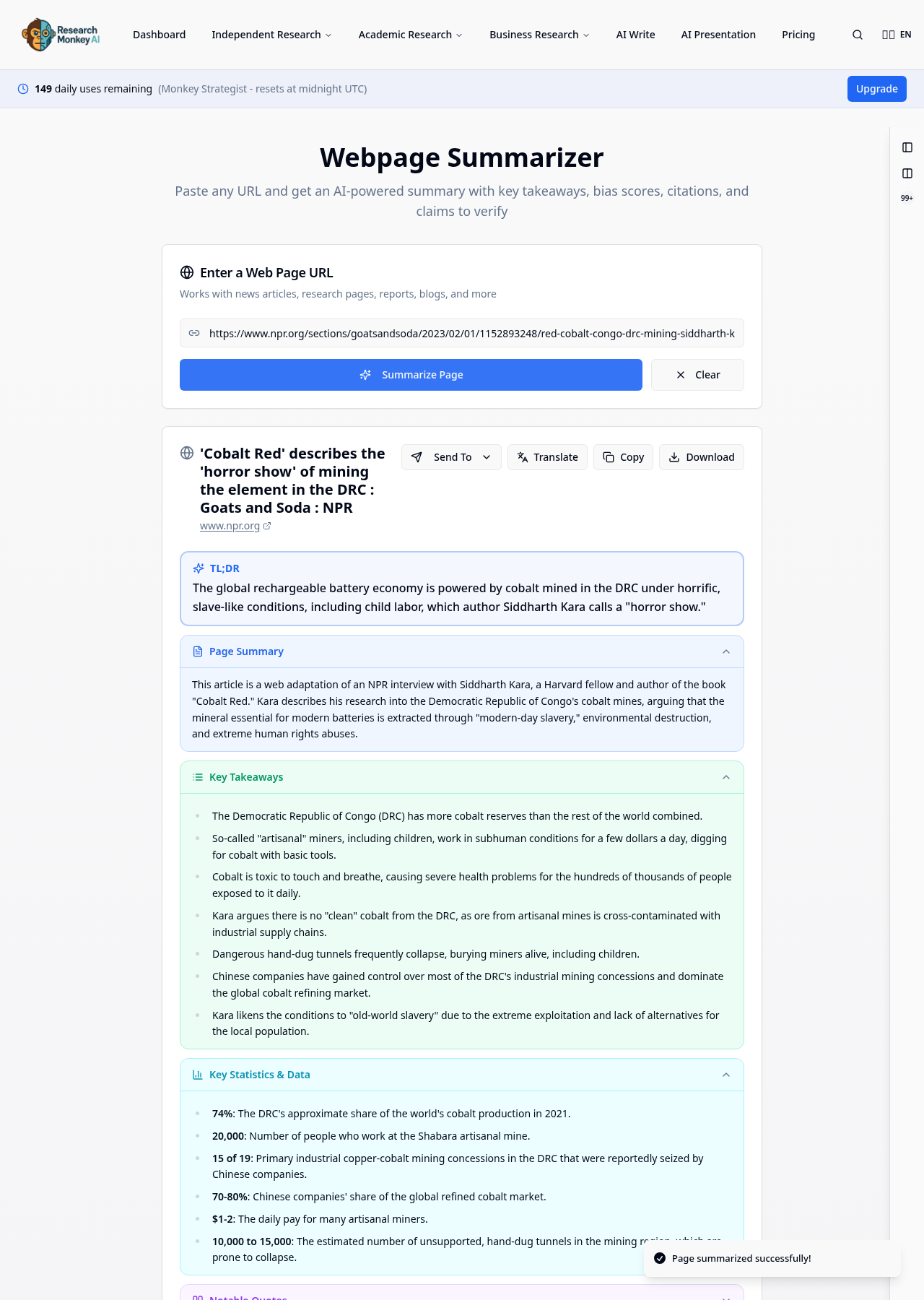
This is a real, unedited-style output — the NPR article 'Cobalt Red' summarized into a TL;DR, summary, takeaways, statistics, quotes, claims to verify and ready-to-paste citations.
'Cobalt Red' describes the 'horror show' of mining the element in the DRC
npr.orgTL;DR
Siddharth Kara's Cobalt Red traces the human cost of artisanal cobalt mining in the Democratic Republic of the Congo, where hundreds of thousands of diggers — including children — work in hazardous conditions to supply a metal essential to almost every rechargeable battery on Earth. Kara argues that the industry's clean, "green" image conceals a supply chain built on extreme poverty, debt bondage, and repression, and that the DRC captures only a tiny fraction of the final value of the cobalt it produces.
Journalist Siddharth Kara spent years visiting cobalt mining sites around Kolwezi and Lualaba province, interviewing miners, children, traders, and local officials. He describes a "horror show" of hand-dug tunnels, toxic dust, injuries, and deaths that go unrecorded. Despite cobalt's critical role in electric vehicles, phones, and laptops, the artisanal miners who extract roughly 15–30% of the DRC's cobalt earn a dollar or two a day and remain locked in debt to traders. Kara contends that the Congolese state, foreign buyers, and electronics companies profit while the laborers bear all the risk. The article frames the "energy transition" as morally compromised if its raw materials are extracted through coerced and child labor, and calls for traceability and a fairer share of revenue to reach the communities that dig the ore.
- Cobalt is unavoidable. It is used in the lithium-ion batteries powering phones, laptops, EVs, and grid storage, and the DRC supplies the majority of the world's supply.
- Artisanal mining dominates the bottom of the chain. Roughly 150,000–200,000 creuseurs dig by hand; their ore is blended into the industrial supply, making "clean" cobalt nearly impossible to guarantee.
- Children are present on the sites. Kara documents boys as young as ten sorting ore and carrying sacks, with injuries and chronic lung exposure.
- Miners earn poverty wages and carry debt. Digging is piece-rate; tools and food are advanced by traders who pay a fraction of the metal's final value.
- The DRC captures little value. Smelting, refining, and battery manufacturing happen elsewhere, so the mining region stays poor despite exporting a strategic resource.
- Traceability is the policy lever. Kara argues that forcing end-to-end traceability and routing more revenue to miners are the minimum conditions for an ethical transition.
- ~70% — the DRC's share of global cobalt mine production cited in the piece.
- 150,000–200,000 — estimated artisanal "creuseurs" working in the Lualaba region.
- $1–$2 / day — typical earnings for an artisanal cobalt digger.
- 15–30% — estimated share of DRC cobalt originating from artisanal (not industrial) mines.
- 6–10 hours — typical daily shift length at the artisanal sites Kara visited.
- Multiple — number of child laborers Kara says he personally interviewed during fieldwork.
Frequently asked questions
- Yes — you can summarize pages free each day. A paid plan raises the daily limit and unlocks follow-up questions, translation and the rest of the research toolkit.
Ready to summarize your first web page?
Paste a URL and get a TL;DR, takeaways, quotes and citations in under a minute — one credit per page.