What is deep research?
Deep research refers to a class of autonomous AI system that supplants single-turn question answering with an orchestrated research workflow: a large language model plans a multi-step investigation, issues iterative retrieval calls across the open web and structured databases, reads the returned documents end-to-end, and synthesises the evidence into a long-form, citation-grounded report[1,2,3]. Recent surveys formalise the paradigm as agentic deep research — a hierarchical Planner–Coordinator–Executor architecture that distinguishes itself from classical retrieval-augmented generation by the depth of its reasoning chain and the breadth of its tool use[4,6].
The category emerged as a productised capability in early 2025, when OpenAI released its Deep Research agent built atop an o3-class reasoning model[8]. Within months, comparable systems were released by Google (Gemini Deep Research), Perplexity (Sonar Deep Research), and Anthropic, and the term has since become a standard tier of capability across major AI platforms[1,3]. Search demand for the phrase deep research exceeds 12,000 monthly queries in the United States and continues to rise.
The defining technical innovation is not a larger underlying model but the closed-loop control structure that surrounds it — plan → search → read → synthesise → cite — executed iteratively and, increasingly, with reinforcement-learning objectives that explicitly reward additional search rather than early termination[6,7].
How AI deep research actually works
Architecturally, contemporary deep-research systems converge on a five-stage agent loop[2,4]:
- Planning. The model rewrites the user query, decomposes it into sub-questions, and selects a retrieval strategy — a step that surveys identify as the dominant determinant of final-report quality[1].
- Searching. Targeted queries are issued against web indexes and, in newer systems, against authenticated academic databases and SEC filings via the Model Context Protocol[8].
- Reading. Retrieved documents are opened, passages relevant to each sub-question are extracted, and irrelevant content is discarded.
- Synthesising. Evidence is grouped by sub-question, agreement and disagreement across sources are surfaced, and the report is drafted section by section[5].
- Citing. Each claim is bound to a source URL; sentence-level citation granularity has been shown to improve downstream verifiability relative to paragraph-level aggregation[12,14].
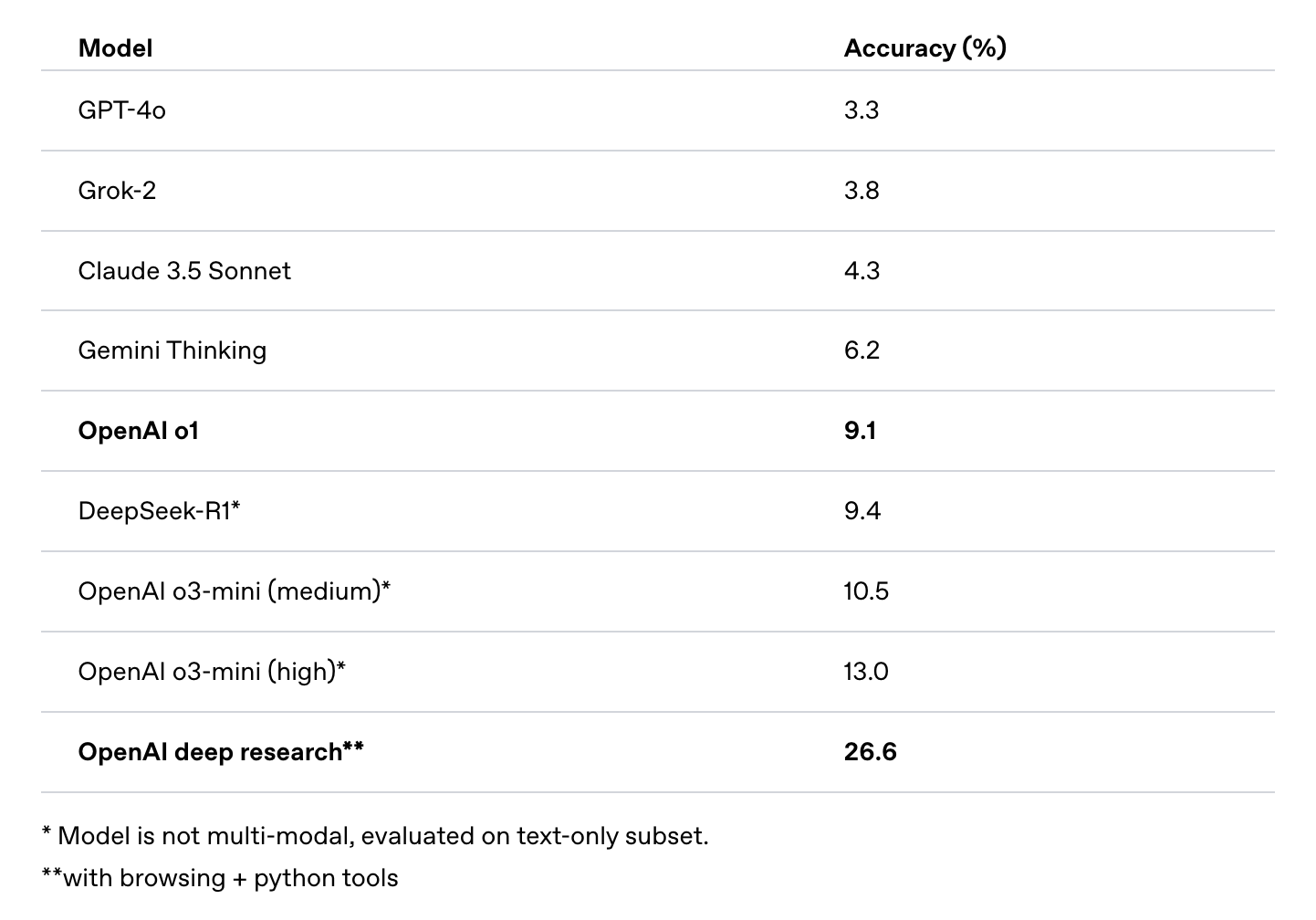
Empirically, agentic deep-research systems substantially outperform standard LLM chat on benchmarks designed to require multi-step retrieval and reasoning. OpenAI's deep research agent reports 26.6% accuracy on Humanity's Last Exam — a frontier-knowledge benchmark of 2,500 expert-curated questions on which most chat models score below 10%[8,10] — and competitive performance on the GAIA general-assistant benchmark[9].
The 6-step deep research methodology
The procedural ingredients that distinguish a defensible research output from a plausible-sounding summary are remarkably consistent across human and machine workflows. The six steps below synthesise recommendations from recent deep-research surveys[1,2,4,5] and from empirical work on citation reliability in long-form generation[11,12,14,15].
Frame a decision-oriented question
Operationalise an underspecified topic as a precise, decision-grounded query. "Tell me about EV batteries" becomes "What are the cost-per-kWh trends for LFP vs NMC chemistries from 2020–2026, and what mechanisms explain the divergence?" Recent surveys identify question framing as the single largest determinant of downstream output quality in deep-research agents (Huang et al., 2025; Shi et al., 2025).
Decompose into atomic sub-questions
Decompose the master query into 4–8 independently answerable sub-questions, each mapped to a section of the final report. This planning step is the architectural difference between agentic deep research and single-turn retrieval-augmented generation (Xu & Peng, 2025; Zhang et al., 2025a).
Diversify the retrieval substrate
Pull from peer-reviewed databases (Google Scholar, PubMed, SSRN, arXiv), primary disclosures (SEC EDGAR, 10-Ks, government registries), and reputable journalism — not solely the open web. Source diversity is a documented predictor of report faithfulness and reduces topical bias inherited from SEO-optimised content (Xi et al., 2025).
Synthesise rather than summarise
Group findings by sub-question, register agreement and disagreement across sources, and surface causal mechanisms. Whereas summarisation enumerates source claims, synthesis produces an inferential structure the reader can act on — the capability gap targeted by the Planner–Coordinator–Executor architectures now dominant in production systems (Li et al., 2025).
Cite every claim inline and atomically
Bind each factual claim to a verifiable URL or DOI at the sentence level. The REASONS benchmark and FACTUM analysis both show that long-form RAG outputs degrade sharply in verifiability when citations are aggregated at section or paragraph granularity rather than the claim level (Tilwani et al., 2024; Dassen et al., 2026).
Spot-check the load-bearing claims
Identify the 3–5 claims on which downstream decisions hinge and verify them against the original source. Recent audits of commercial deep-research agents report citation-error rates from 11–57% depending on model and domain, making targeted verification the highest-yield human-in-the-loop intervention (Rao et al., 2026; Cross-Model Audit, 2026).
Deep research prompts that work
Prompt formulation is the dominant lever on deep-research output quality. Surveys consistently report that under-specified queries — those lacking a decision frame, a source constraint, or an output schema — produce shallower retrieval and weaker synthesis than well-scoped prompts[1,4]. Three patterns have been shown to improve faithfulness and verifiability:
1. Specify the decision
2. Constrain the source mix
3. Demand structure up front
If you don't want to write the prompt yourself, the AI Research Brief Generator turns a one-line question into a structured prompt with sub-questions, source recommendations, and an outline — paste the result into any deep research tool.
Best deep research AI tools compared
No single deep-research system dominates on every dimension. Comparative surveys evaluate the leading agents across retrieval breadth, reasoning depth, citation faithfulness, and benchmark accuracy (notably GAIA[9] and Humanity's Last Exam[10]); the appropriate choice depends on whether the task prioritises analytical depth, recency, citation transparency, or end-to-end workflow coverage[1,3,5].
OpenAI Deep Research (o3-class agent)
Best for: General-purpose breadth across heterogeneous sources
Google Gemini Deep Research
Best for: Time-sensitive topics tied to recent web content
Perplexity Pro / Sonar Deep Research
Best for: Citation-first answers with rapid turnaround
Research Monkey AI
Best for: Academic and business research workflows end-to-end
When to use deep research (and when not to)
Use it for
- Literature reviews and academic background research
- Market sizing and competitor landscape work
- Diligence on a company, technology, or policy area
- Synthesizing 10+ sources you don't have time to read
- Drafting a structured first pass you'll edit yourself
Skip it for
- Anything where wrong information has real consequences (medical, legal, regulatory) without expert review
- Questions answerable by a single source you already know
- Highly proprietary topics where the best sources aren't on the public web
- Breaking news from the last few hours
- Tasks that need your own creative voice, not a synthesis
Limitations & how to verify AI research
Deep-research agents deliver genuine capability gains over single-turn LLM chat, yet a growing evaluation literature documents systematic failure modes that warrant a verification protocol rather than uncritical adoption.
Empirical audits of commercial deep-research systems document three failure modes with non-trivial prevalence:
- Citation hallucination. A 2026 cross-model audit of ten commercially deployed LLMs across four academic domains generated 69,557 citation instances and verified them against CrossRef, OpenAlex, and Semantic Scholar; observed hallucination rates ranged from 11.4% to 56.8%, strongly modulated by model, domain, and prompt framing[15]. The same study found that multi-model consensus (≥3 LLMs citing the same work) raised accuracy to 95.6%, a 5.8× improvement. Reference-hallucination analyses of deep-research agents specifically — including URL fabrication and quote misattribution — corroborate this pattern[11].
- Source bias and retrieval drift. When retrieval over-weights SEO-optimised content, the synthesised report inherits its slant. Survey work on deep search agents identifies source-diversity constraints in the prompt as the most effective mitigation[5].
- Surface-level fluency masking factual error. Mechanistic analyses such as FACTUM show that long-form RAG outputs can read as authoritative while containing claims that are unsupported by their cited passages — a failure that is harder to detect than overt hallucination[14].
The most cost-effective verification protocol consistent with this literature is targeted human review of the 3–5 load-bearing claims: open the cited source, confirm the passage exists, and confirm it supports the claim as stated. The REASONS benchmark and CiteCheck framework both demonstrate that simple retrieval-grounded checks of this kind catch the majority of fabricated or misattributed references[12,13].
For outputs containing direct quotations, the AI Fact Check Quotes tool automates source-grounded verification before publication.
Run your own deep research workflow
Research Monkey AI breaks the deep research pipeline into purpose-built tools. Use them individually or chain them into a full workflow.
Turn a question into a structured research plan with sub-questions, source types, and an outline.
Search peer-reviewed academic sources by topic and pull citations instantly.
Synthesize multiple papers into a structured literature review with proper citations.
Generate APA, MLA, Chicago, Harvard, IEEE, and BibTeX citations in seconds.
Distill long articles, white papers, and reports into the points that actually matter.
Verify quotes and claims against original sources before they end up in your output.
Getting started in 10 minutes
- Minute 1–2: Write your research question on one line. Then rewrite it to specify the decision it should help you make.
- Minute 3–4: Run it through the AI Research Brief Generator to get sub-questions and a source plan.
- Minute 5–7: Paste the brief into your deep research tool of choice (or run each sub-question through the Research Paper Finder and Web Page Summarizer).
- Minute 8–10: Spot-check the top 3 claims, fix anything the model got wrong, and you have a credible draft.
Frequently asked questions
What is deep research in AI?
Deep research denotes a class of agentic AI system that decomposes a complex query into sub-questions, executes multi-step retrieval across heterogeneous sources, synthesises the evidence, and emits a cited long-form report — typically over 5–30 minutes of compute. Recent surveys formalise the paradigm as a Planner–Coordinator–Executor hierarchy distinct from single-turn retrieval-augmented generation (Huang et al., 2025; Xu & Peng, 2025; Li et al., 2025).
Is AI deep research accurate?
Accuracy is task-, model- and domain-dependent. OpenAI's deep research agent reports 26.6% accuracy on Humanity's Last Exam, a frontier-knowledge benchmark on which most chat models score under 10% (OpenAI, 2025; Phan et al., 2026). However, a 2026 audit across ten commercial LLMs and four academic domains observed citation-hallucination rates spanning 11.4%–56.8%, and reference-hallucination analyses of deep-research agents specifically document URL fabrication and misattribution at non-trivial rates (Rao et al., 2026; Cross-Model Audit, 2026). Verification of load-bearing claims remains essential.
How long does an AI deep research run take?
Typical runtimes range from 5–30 minutes depending on tool, topic complexity, and number of tool calls. Surveys characterise deep-research agents as deliberately compute-expensive: longer reasoning traces and broader retrieval correlate with higher GAIA and HLE scores (Mialon et al., 2023; Shi et al., 2025).
Can AI deep research replace human researchers?
Current literature positions deep research as augmentation rather than replacement. Agents handle retrieval breadth and first-pass synthesis effectively but underperform human experts on tasks requiring novel hypothesis formation, domain-specific tacit knowledge, and adjudication between conflicting primary sources (Zhang et al., 2025a; Shi et al., 2025).
What is the best free deep research tool?
Google Gemini provides a genuine deep-research capability on its free tier. For academic workflows, Research Monkey AI's free tools — Research Paper Finder, Web Page Summarizer, TLDR Generator — cover the retrieval, summarisation, and citation steps of the pipeline without a subscription.
How does deep research differ from standard LLM chat?
Standard LLM chat answers from parametric memory plus a single retrieval call; deep research executes an iterative plan–search–read–synthesise loop with multi-source grounding. Zhang et al. (2025b) frame this as the transition from web-search-augmented LLMs to agentic deep research, in which reasoning explicitly incentivises additional search rather than terminating at the first plausible answer.
References
Sources cited inline throughout this guide. Where available, links resolve to the open-access preprint or publisher landing page.
- [1]Huang, Y., Chen, Y., Zhang, H., et al. (2025). Deep Research Agents: A Systematic Examination and Roadmap. arXiv:2506.18096. https://arxiv.org/abs/2506.18096
- [2]Xu, R. & Peng, J. (2025). A Comprehensive Survey of Deep Research: Systems, Methodologies, and Applications. arXiv:2506.12594. https://arxiv.org/abs/2506.12594
- [3]Zhang, W., Li, X., Zhang, Y., et al. (2025). Deep Research: A Survey of Autonomous Research Agents. arXiv:2508.12752. https://arxiv.org/abs/2508.12752
- [4]Shi, Z., Chen, Y., Li, H., et al. (2025). Deep Research: A Systematic Survey. arXiv:2512.02038. https://arxiv.org/abs/2512.02038
- [5]Xi, Y., Lin, J., Xiao, Y., et al. (2025). A Survey of LLM-based Deep Search Agents: Paradigm, Optimization, Evaluation, and Challenges. arXiv:2508.05668. https://arxiv.org/abs/2508.05668
- [6]Li, W., Chen, Z., Lin, J., et al. (2025). Reinforcement Learning Foundations for Deep Research Systems: A Survey. arXiv:2509.06733. https://arxiv.org/abs/2509.06733
- [7]Zhang, W., Li, Y., Bei, Y., et al. (2025). From Web Search towards Agentic Deep Research: Incentivizing Search with Reasoning Agents. arXiv:2506.18959. https://arxiv.org/abs/2506.18959
- [8]OpenAI (2025). Introducing deep research. OpenAI Research Blog, 2 February 2025. https://openai.com/index/introducing-deep-research/
- [9]Mialon, G., Fourrier, C., Swift, C., Wolf, T., LeCun, Y. & Scialom, T. (2023). GAIA: a benchmark for general AI assistants. arXiv:2311.12983. https://arxiv.org/abs/2311.12983
- [10]Phan, L., Gatti, A., Han, Z., et al. (2026). Humanity's Last Exam. Nature 649, 1139–1146. https://lastexam.ai/
- [11]Rao, D., Wong, E. & Callison-Burch, C. (2026). Detecting and Correcting Reference Hallucinations in Commercial LLMs and Deep Research Agents. arXiv:2604.03173. https://arxiv.org/abs/2604.03173
- [12]Tilwani, D., Saxena, Y., Mohammadi, A., Raff, E., Sheth, A. & Parthasarathy, S. (2024). REASONS: A Benchmark for Retrieval and Automated Citations of Scientific Sentences using Public and Proprietary LLMs. arXiv:2405.02228. https://arxiv.org/abs/2405.02228
- [13]Khajavi, K., Sadeghi, S., Adhikari, R. & Tessier, A. (2026). CiteCheck: Retrieval-Grounded Detection of LLM Citation Hallucinations in Scientific Text. arXiv:2605.27700. https://arxiv.org/abs/2605.27700
- [14]Dassen, M., Kotula, B., Murray, K., Yates, A., Lawrie, D., Mayfield, J. & Duh, K. (2026). FACTUM: Mechanistic Detection of Citation Hallucination in Long-Form RAG. arXiv:2601.05866. https://arxiv.org/abs/2601.05866
- [15]Cross-Model Audit (2026). How LLMs Cite and Why It Matters: A Cross-Model Audit of Reference Fabrication in AI-Assisted Academic Writing. arXiv:2603.03299. https://arxiv.org/abs/2603.03299
Start your deep research workflow
40+ purpose-built AI research tools — from question framing to literature review to citation. Free to start.